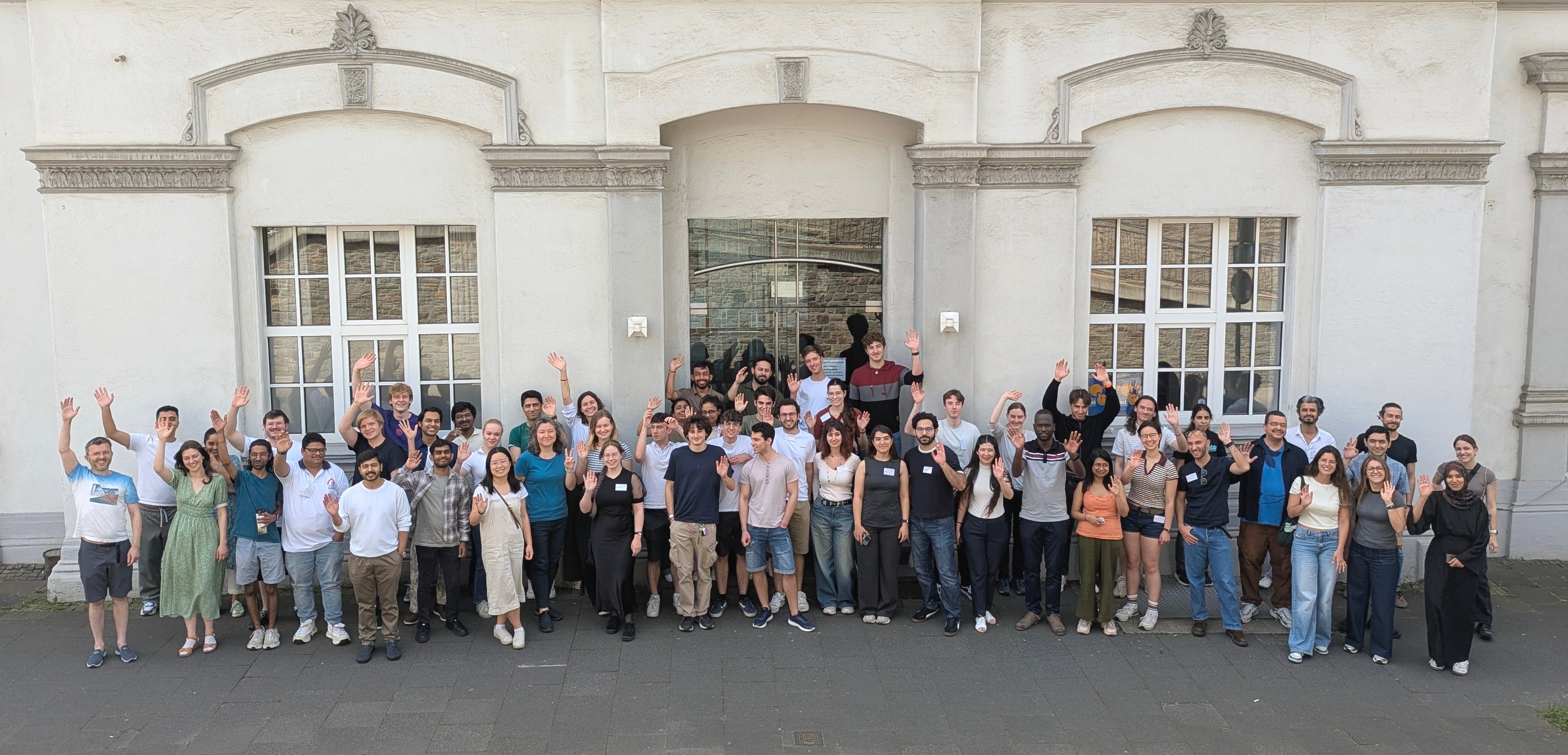
The PenteQost Spring School on Quantum Science 2026 has taken place. The organisers thank everyone, speakers, participants, and all the helping hands for the great experience!
If you want more quantum, consider the upcoming events from our project partners at the University of Gdánsk, Poland:
- The Workshop on the Physics of Quantum Chips (PQC) 2026, taking place Aug 24--26 at the University of Gdánsk.
- The Q-Con conference: Quantum, Applied. Value, Delivered.
A business-focused conference on quantum technologies, taking place on Sep 11th in Gdánsk. - The Q-Camp Quantum Summer School 2026, an in-depth two-week summer academy on quantum technologies, taking place Aug 31 -- Sep 10 in Gdánsk.

PenteQost-26 is the third edition of our interdisciplinary and international undergraduate spring school on the Fundamentals of Quantum Science. Building on the success of the first two editions in Siegen, this year the event will once again be hosted by the University of Siegen, Germany, in cooperation with the University of Gdánsk, Poland, funded by the Federal Ministry of Research, Technology and Space (BMFTR) within the project MasterQE.
The school will take place from Friday afternoon, 22 May, to Tuesday noon, 26 May 2026, during the long Pentecost weekend so that it does not overlap with regular summer-semester lectures at German universities. Students, graduates, and professionals are welcome to join us in exploring quantum science and its technological applications through lectures, interactive discussions, and collaborative sessions in an international setting.
Topics & Speakers
You will learn the theoretical fundamentals and the experimental practice of quantum science and technology, which includes:
Quantum Foundations & Open Quantum Systems: Explore the fundamental principles of quantum mechanics with a focus on open quantum systems. Learn how interactions with the environment affect quantum dynamics and how these effects can be modeled using completely positive maps and master equations. Understand the role of noise and decoherence and their impact on quantum technologies.
Bell Inequalities & Quantum Nonlocality:
Learn how Bell inequalities are used to test quantum nonlocality and to distinguish classical from quantum correlations. Topics may include the formulation of Bell experiments, interpretation of violations, and connections to entanglement and quantum information tasks.
Semidefinite Programming in Quantum Science
Learn how semidefinite programming provides a powerful optimization framework for problems in quantum information and quantum foundations. Applications include the characterization of quantum states and channels, entanglement detection, Bell inequalities, and bounds in quantum metrology and complexity theory.
Quantum Computation and Computational Complexity:
Develop an understanding of the computational power and limitations of quantum systems. Topics may include basic models of quantum computation, the role of entanglement in algorithms, and how complexity theory is used to classify computational problems in classical and quantum settings.
Quantum Technologies and Precision Measurements:
Learn about experimental platforms and techniques used in contemporary quantum technologies. This may include trapped-ion systems, precision spectroscopy, and quantum-enhanced measurement schemes, with applications ranging from timekeeping to tests of fundamental physics.
All lectures will be given in English, and you will interact with leading international scientists in the respective fields.
Confirmed speakers:
-
Alessandra Colla (University of Freiburg) – works on the theory of open quantum systems and non-equilibrium quantum thermodynamics, including irreversibility and entropy production, and related aspects of non-Markovian dynamics
-
María García Díaz (Universidad Politécnica de Madrid / MathQI, Universidad Complutense de Madrid) – works on quantum information and quantum foundations, with research interests including open quantum systems, quantum coherence, and quantum simulation.
- Lina Vandré (TU Vienna, neQxt) – works on quantum error correction and quantum communication networks, specifically on stabilizer states and graph representations
-
Matthias Kleinmann (University of Münster) – works on quantum information theory and the foundations of quantum theory, including Bell inequalities, contextuality, and the characterization of non-classical correlations.
-
Patrick Huber (University of Siegen) – works in experimental quantum optics with trapped ions, including quantum information experiments and control techniques in trapped-ion platforms.
-
Gizéh Rangel-de Lázaro (Universidad de Málaga)– cross-disciplinary specialist in museistics and the study of anthropological, archaeological, and natural sciences museum collections by using digitisation, AI, and immersive reality approaches
Interested? Register HERE.
Target Audience & Prerequisites
International undergraduate or graduate students from all fields of study are welcome, as well as interested professionals and freelancers, with an interest in modern quantum science and technology.
We recommend that you have essential knowledge of linear algebra and analysis, as typically taught in introductory undergraduate math courses. We also recommend that you familiarize yourself with the basic concepts of quantum physics beforehand. For example, you may already have attended a quantum physics lecture in your university before. If not, we can recommend the following online courses and textbooks:
- (Book) "Quantum Computation and Quantum Information" by M. Nielsen and I. L. Chuang – Chapters 1 and 2.
- (Online resource) "Quantum computing for the very curious" and "Quantum mechanics distilled" by A. Matuschak and M. Nielsen
- (Video lectures) "Introduction to Quantum Information Science" by A. Ekert – Lectures 1 to 4.
Graduate students with advanced knowledge in quantum science are welcome to participate, but they should note that this school is aimed at the introductory level.
Hosts
The PenteQost school is jointly organized by quantum scientists Giulio Gasbarri, Stefan Nimmrichter, and Otfried Gühne at the University of Siegen and Paweł Mazurek at the University of Gdánsk in Poland.
The responsible research group in Siegen is led by Otfried Gühne, together with the PIs Chau Nguyen and Stefan Nimmrichter. We investigate all aspects of quantum foundations, quantum information theory, and quantum metrology. On the experimental side, Christof Wunderlich’s research group is developing a cutting-edge platform for quantum computing with trapped ions. The recently founded the spin-off company eleQtron is currently developing chips based on this platform.
Check out also our new "Quantum Science" master program, an interdisciplinary Master study program open for international students with a Bachelor’s degree in physics, mathematics, computer science, and electrical engineering.
Siegen is located centrally in Germany, around 125km northwest of Frankfurt and 90km east of Cologne. It can be easily reached via train or car, and nearby international airports are in Frankfurt, Cologne, and Düsseldorf. Downtown Siegen offers many pubs, restaurants and cafes, but also theaters, cinemas and concert halls. Further travel information can be found in the side menu.
Financial support
Financial support will be provided for selected students. The exact amount will be defined depending on the final number of applicants, but should be enough to cover a large part of the expenses. Non-student participants cannot be granted financial support.
TLDR
- What: Interdisciplinary and international school on Fundamentals of Quantum Science (quantum foundations, quantum cryptography, quantum computing, quantum complexity theory, trapped ions etc.)
- For whom: Interested undergraduate and graduate students, working professionals, freelancers with a basic understanding of linear algebra and elementary quantum mechanics.
- When: Friday afternoon, May 22, to Tuesday noon, May 26, 2026; registration deadline is May 1, 2026, at 23:59 (Berlin time).
- Where: University of Siegen, Germany, conveniently located between Frankfurt and Cologne.