Choose timezone
Your profile timezone:
Neutral-atom quantum computers use the arrays of ultracold atoms assembled with optical tweezers, in which each single atom serves as a high-quality qubit, whereas the whole system operates at room temperatures. We use rubidium (Rb) atoms as qubits and have various core competences including ultrafast laser technologies that allow for an ultrafast two-qubit gate operating in nanoseconds, faster than any other two-qubit gates with neutral atoms by two orders of magnitude [1]. This has been made possible with two nearby ultracold Rb atoms excited simultaneously with an ultrashort laser pulse to a Rydberg state far beyond the Rydberg blockade regime, as schematically shown in Fig. 1 [1-5]. We have also been developing underlying technologies that would improve the fidelity of this ultrafast gate, such as a stable gate-operation laser and an automated system for ultraprecise initialization of many qubits [6-8].
In another direction of our R&D, we are currently developing a full-stack quantum computer with 500 qubits. This would be Japan’s first full-stack quantum computer with neutral atoms, and one of only a few in the world, scheduled to start its full operation in this Japanese fiscal year 2025.
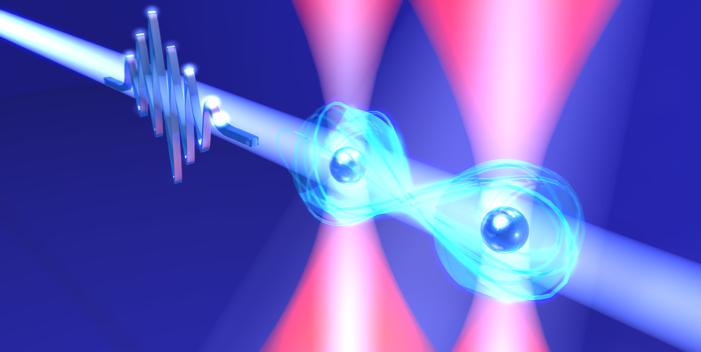
Figure 1. Conceptual diagram of the ultrafast two-qubit gate for quantum computing with neutral atoms. Two single atoms captured in optical tweezers (red light) with a separation of a micrometer are entangled with an ultrafast laser pulse (blue light) shone for only 10 picoseconds [1]. Image source: Dr. Takafumi Tomita (IMS).
References
[1] Y. Chew et al., Nat. Photonics. 16, 724 (2022). (Front Cover Highlight)
[2] N. Takei et al., Nature Commun. 7, 13449 (2016).
Highlighted by Science 354, 1389 (2016); IOP PhyscisWorld.com (2016).
[3] M. Mizoguchi et al., Phys. Rev. Lett. 124, 253201 (2020).
[4] V. Bharti et al., Phys. Rev. Lett. 131, 123201 (2023).
[5] V. Bharti et al., Phys. Rev. Lett. 133, 093405 (2024).
[6] Y. T. Chew et al., Phys. Rev. A 110, 053518 (2024).
[7] T. P. Mahesh et al., Opt. Lett. 50, 403 (2025).
[8] V. Lienhard et al., Phys. Rev. Lett., in press.
Invited by AG Wunderlich
